
How to Prepare Your Car for Shipping: Printable Checklist
How to prepare your car for shipping, step by step: a printable timeline checklist from two weeks out to delivery day, plus photo and document lists to save.
Most car shipping problems are small and avoidable. A driver arrives and the gas tank is full. A toll tag charges you for a trip across three states. Nobody took photos before pickup, so a scratch at delivery turns into an argument. Each of these takes about two minutes to prevent if you know about it ahead of time.
This guide is built as a checklist you can print, save to your phone, or share with whoever is meeting the driver. It is organized by time: two weeks before pickup, one week before, the day before, pickup day, and delivery day. If you have not booked yet, start by getting an instant car shipping quote so you know your pickup window and can plan backward from it.
Already know the basics? Our car shipping preparation tips cover the "why" behind each step. This page is the "what and when," in order.
Quick Answer: How Do You Prepare a Car for Shipping?
- Two weeks out: book with a licensed carrier, confirm dates and addresses, and fix any leaks or mechanical issues.
- One week out: wash the car, remove personal items and toll tags, and gather your documents.
- The day before: leave about a quarter tank of fuel, check tires and battery, and take dated photos of every side.
- At pickup and delivery: walk around the car with the driver, note every mark on the Bill of Lading, and keep your copy.
Two Weeks Before Pickup
This is when you lock in the big decisions. Give yourself more lead time in summer or during snowbird season.
- Request quotes and book your shipment with a clear pickup window
- Check the carrier's USDOT and MC numbers on the FMCSA SAFER system (see how to verify a car shipping company)
- Ask who will actually move your car, and read our guide to brokers vs. carriers if you are not sure
- Confirm pickup and delivery addresses, including any gate codes or HOA truck rules
- Choose a backup person who can release or receive the car if you cannot be there
- Schedule repairs for leaks, a weak battery, or a low tire
- Tell the specialist about anything unusual: lift kits, racks, low ground clearance, or a car that does not run
- Ask your insurance company whether your policy covers the car while it is in transit
If your car does not start or roll on its own, follow our guide on how to ship a non-running car, since it needs a truck with a winch.
One Week Before Pickup
Now you get the car itself ready.
- Wash the car so you can see every scratch and dent
- Remove all personal belongings, including the trunk and under the seats
- Remove or switch off toll tags and parking passes
- Take out aftermarket electronics, like dash cams and radar detectors
- Remove loose exterior items: bike racks, ski racks, roof boxes, custom spoilers if possible
- Fold in the mirrors and retract or remove any antenna that does not go down
- Make a spare key, since the driver will need one key for the trip
- Gather the documents listed in the next section
- Confirm the pickup window with your specialist
Documents to Have Ready
Requirements vary, so confirm with your carrier. These are the items most people should have on hand.
| Document | Why You Need It | Keep in the Car? |
|---|---|---|
| Booking confirmation | Shows the agreed price, dates, and addresses | No, keep a copy with you |
| Photo ID | The driver may confirm who is releasing the car | No |
| Vehicle registration | Proof the car is legally registered | Often yes, check with carrier |
| Proof of insurance | Shows your own coverage on the vehicle | Often yes, check with carrier |
| Title or lienholder letter | Only if requested, such as some dealer or auction pickups | No, never leave the title in the car |
| Gate pass or release form | Needed for auction yards, dealers, and storage lots | Give to the driver at pickup |
| Bill of Lading | The inspection and receipt document for your shipment | Keep your signed copy |
If you are moving to a new state, our moving out of state car checklist covers title transfer, registration, and insurance in more detail.
The Day Before Pickup
These quick checks prevent most pickup-day delays.
- Leave the fuel tank at about one quarter full or less
- Check tire pressure and top off any low tires
- Make sure the battery is charged and the car starts easily
- Turn off or disable the car alarm, or tell the driver how to shut it off
- Remove garage door openers and house keys from the car
- Lock or secure the gas cap
- Take dated photos and a short video of the whole car (see the photo checklist below)
- Write down the odometer reading
- Charge your phone and save the driver's phone number
Photo Checklist: Every Angle to Capture
Photos are your best record of the car's condition before it ships. Take them in daylight, after a wash, and make sure your phone saves the date and time.
| Angle | What to Capture |
|---|---|
| Front, straight on | Bumper, grille, headlights, hood edge |
| Rear, straight on | Bumper, trunk lid, taillights, plate |
| Driver side, full length | Doors, panels, mirror, wheels |
| Passenger side, full length | Doors, panels, mirror, wheels |
| All four corners at 45 degrees | Bumper corners, where most scrapes happen |
| Roof | Sunroof, roof rails, any hail marks |
| Each wheel close up | Rims, curb rash, tire condition |
| Windshield and glass | Chips and cracks |
| Dashboard | Odometer reading and any warning lights |
| Existing damage close up | Every scratch, dent, and chip you already know about |
| Underside (if possible) | Low-hanging parts, for lowered or modified cars |
A slow walk-around video, under two minutes, is a great backup to your photos.

What Not to Leave in the Car
Carriers are generally not set up to transport household goods, and their cargo insurance usually does not cover personal items left inside. Some carriers allow a small, light box in the trunk, but always ask first.
| Item | Why to Remove It |
|---|---|
| Personal belongings and boxes | Usually not covered by carrier insurance, adds weight |
| Toll tags and parking passes | Can charge you as the truck passes toll points |
| Garage door openers and house keys | A security risk if lost |
| Important papers, title, passport | Hard to replace if lost |
| Electronics and chargers | Theft risk and not covered |
| Loose items in cup holders and door pockets | Can rattle around and cause damage |
| Child car seats | Better moved with your household goods |
| Hazardous items | Spare fuel cans, propane, aerosols, and similar items are not allowed |
| Firearms and ammunition | Generally not allowed, ask before you book |
At Pickup
Pickup usually takes 15 to 30 minutes. Do not rush it.
- Meet the driver at the agreed spot, which may be a nearby lot if the truck cannot fit on your street
- Walk around the car together and point out existing damage
- Check that every mark is written on the Bill of Lading, then sign it
- Take a photo of the signed Bill of Lading
- Hand over one key and keep the spare
- Confirm the delivery window and the best number to reach the driver
- Ask how and when you will get updates during transit
At Delivery
This is the most important inspection. Take your time even if the driver is in a hurry.
- Inspect the car in good light, using a flashlight if it is dark
- Compare its condition to your pickup photos and the Bill of Lading
- Check the roof, bumpers, wheels, and lower panels
- Check the odometer against your notes
- Write any new damage on the Bill of Lading before you sign
- Take photos of any new damage with the driver present
- Pay any balance due using the agreed payment method
- Keep your copy of the signed Bill of Lading
If you find damage, report it on the Bill of Lading at delivery and file with the carrier as soon as possible. Follow the carrier's claim deadline.
Extra Steps for Electric Vehicles
Electric vehicles need a slightly different routine. Our full guide on how to ship an electric car covers the details, but here are the basics:
- Charge the battery to roughly 30 to 50 percent, unless your carrier asks for a different level
- Turn off features that drain the battery, like sentry or camp modes
- Tell the specialist the make and model, since EVs are often heavier than similar gas cars
- Show the driver how to put the car in transport or tow mode
- Leave the charging cable at home unless the carrier asks for it
Extra Steps for Convertibles
Soft tops are more exposed on an open carrier. Before pickup:
- Close and latch the top fully, and check that it seals
- Look for rips or loose seams that could tear at highway speed
- Remove anything loose inside the cabin
- Consider enclosed transport for older soft tops or high-value convertibles
Print It, Share It, Use It
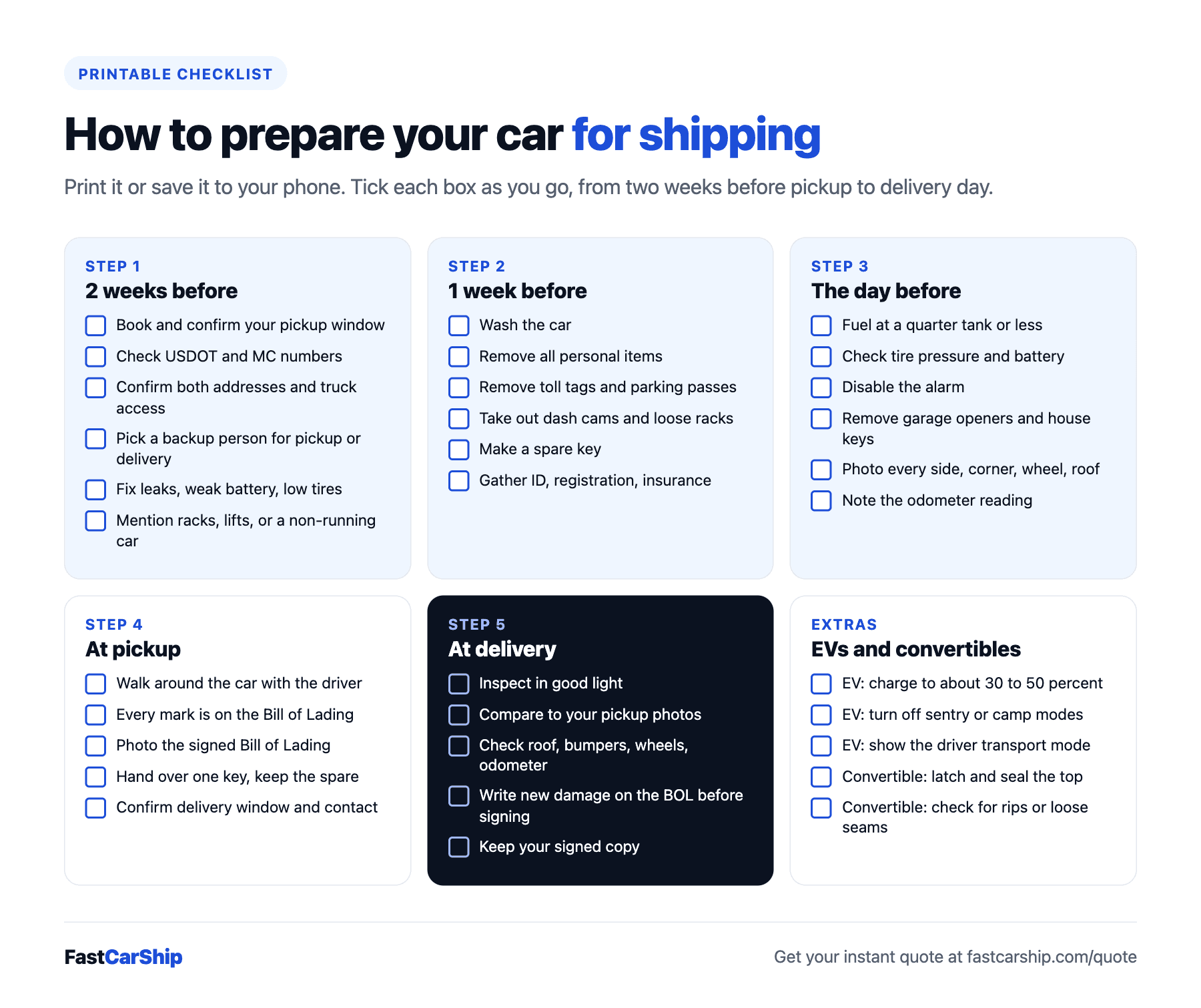
Save the infographic at the top of this page or print this guide and stick it on the fridge. If someone else is handling pickup or delivery, send them the pickup and delivery sections so they know what to check. You can also see the full process on our how it works page.
Have not booked yet? You can check your price in under a minute and start your two-week countdown today.
Ready for a Smooth Pickup
Preparing your car for shipping comes down to timing. Book and check your carrier two weeks out, clean and empty the car the week before, take photos the day before, and inspect carefully at both ends. Follow the checklist, and pickup day becomes a quick handoff instead of a scramble.
Get your free instant quote and lock in your pickup window. An auto transport specialist will contact you shortly with an accurate quote.
Frequently Asked Questions
How much gas should I leave in my car for shipping?
Leave about a quarter tank or less. That is enough for the driver to load and unload the car and drive it a short distance, while keeping weight down. A full tank is not needed.
Can I leave personal items in my car when shipping it?
It is best to remove everything. Carrier insurance usually does not cover personal items, and extra weight can cause problems. Some carriers allow a small box in the trunk, but ask before you pack anything.
Should I wash my car before shipping it?
Yes. A clean car makes it easy to spot existing scratches and dents during the pickup inspection. Dirt can hide damage, which makes it harder to show what changed during transport.
What documents do I need to ship my car?
Most shipments need a booking confirmation, photo ID, and access to your registration and insurance. Auction, dealer, and storage pickups often need a release form or gate pass. Confirm the exact list with your carrier.
What should I check when my car is delivered?
Walk around the car with the driver, compare it to your pickup photos, and check the roof, bumpers, wheels, and odometer. Write any new damage on the Bill of Lading before you sign it.
Do I need to be there for pickup and delivery?
Not always. You can authorize a friend or family member to meet the driver. They should know how to inspect the car, sign the Bill of Lading, and hand over or accept the keys.