
How to Ship a Non-Running (Inoperable) Car: Costs and Tips
Need to ship an inoperable car? Learn what counts as non-running, how winch carriers work, what it typically costs extra, and how to avoid surprise fees.
A car that will not start can still be shipped across the country. Project cars, auction buys, salvage vehicles, and cars that broke down far from home move on carrier trucks every day. The difference is that the carrier needs the right equipment and an honest description of the car before the truck shows up.
Shipping an inoperable car usually costs a bit more and can take a little longer to schedule, because fewer trucks carry a winch. Most of the stress comes from surprises at pickup: a driver who arrives without the right gear, a car with locked wheels, or a fee nobody mentioned. This guide shows you how to avoid all of that. If you already know your route, you can get an instant quote for your non-running car and note that it is inoperable.
Below, you will learn what "inoperable" means to a carrier, what it typically adds to the price, and the few things your car still needs to be able to do.
Quick Answer: How Do You Ship a Car That Doesn't Run?
- Tell the truth up front. Mark the car as inoperable when you request a quote so a carrier with a winch is assigned.
- Expect an extra fee of roughly $100 to $250 in most cases, on top of the normal route price.
- The car usually must roll, steer, and brake. Inflated tires and working steering let the driver winch it on safely.
- Have the keys ready. Even if the engine is dead, the driver needs keys to unlock the steering and shift into neutral.
- Flatbed or forklift loading is an option for cars that cannot roll at all, but it costs more and takes longer to arrange.
What Counts as an Inoperable Car?
In auto transport, a car is inoperable if it cannot be driven onto and off the carrier under its own power. That includes cars that:
- Will not start, even with a jump
- Start but cannot move into gear or drive
- Have no working brakes or no working steering
- Have flat tires, missing wheels, or seized wheels
- Have no keys
- Are missing major parts, like an engine or transmission
A car with a check engine light, a noisy exhaust, or a cracked windshield is usually still operable. If it can drive up a ramp and stop safely, carriers treat it as a running car. If you are not sure, describe the problem in plain words when you book and let the specialist decide.
Operable vs. Inoperable: What It Means for Your Shipment
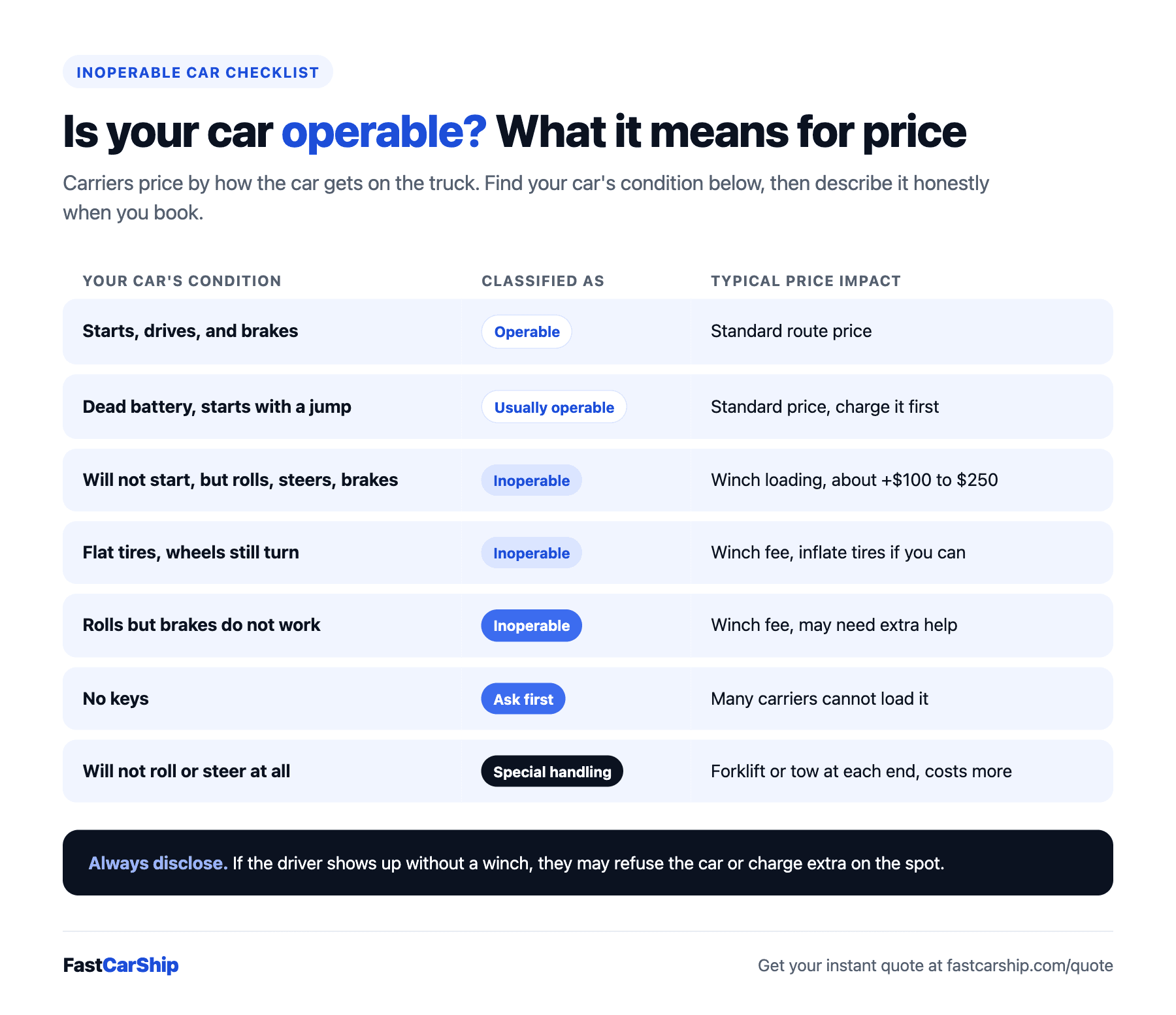
| Condition | Usually Classified As | What It Means |
|---|---|---|
| Starts, drives, brakes | Operable | Standard price and loading |
| Dead battery, starts with a jump | Usually operable | Charge the battery before pickup |
| Will not start, rolls and steers | Inoperable | Winch loading, extra fee |
| Rolls but has no brakes | Inoperable | Winch loading, driver may need extra help |
| Flat tires, wheels still turn | Inoperable | Inflate tires if possible before pickup |
| Will not roll or steer | Inoperable, special handling | Forklift or flatbed, higher cost |
| No keys | Inoperable | Many carriers cannot load it, ask first |
How Carriers Load a Non-Running Car
Most cars ship on open carriers that use ramps. A running car is simply driven up. A non-running car needs a winch, a motorized cable that pulls the car up the ramp and onto the deck. Not every truck has one, which is why an honest description matters so much.
Here is how a typical winch loading works:
1. The driver hooks the winch cable to a solid point on the car's frame.
2. Someone steers while the winch slowly pulls the car up the ramp.
3. The driver secures the car with straps or chains like any other vehicle.
4. At delivery, the process runs in reverse, using gravity and the winch to lower the car.
For this to work, the car needs to roll freely and steer. If the wheels are locked or the steering is seized, a winch cannot safely pull it into place.
What If the Car Cannot Roll at All?
Cars with missing wheels, a locked transmission, or heavy damage usually need a forklift or a flatbed tow truck at pickup and delivery. Some carriers arrange this, and some ask you to have equipment ready, like a local tow truck that loads the car onto the carrier. This adds cost and planning time, so mention it on day one.
How Much Extra Does It Cost to Ship an Inoperable Car?
For a car that rolls, steers, and brakes, the inoperable fee is usually about $100 to $250 on top of the normal price. The fee covers the winch equipment, the extra loading time, and the fact that fewer trucks can take the job.
| Situation | Typical Added Cost | Notes |
|---|---|---|
| Rolls, steers, brakes, needs winch | About $100 – $250 | The most common inoperable case |
| Enclosed transport, non-running | Often higher | Fewer enclosed trucks carry winches |
| Cannot roll, needs forklift or tow | Varies widely | Equipment at both ends adds cost |
| Large truck or SUV, non-running | Higher than a sedan | Weight and size add to the base price |
Remember that the inoperable fee is added to the regular route price, which depends on distance, season, and vehicle size. Our car shipping cost guide breaks those factors down. You can also check your price in under a minute and add the inoperable detail when a specialist calls.
Why You Must Disclose a Non-Running Car
It is tempting to leave out the problem and hope for the regular price. Do not do it. If the driver arrives with a truck that has no winch, they may:
- Refuse to load the car, which means a new booking and lost days
- Charge an extra fee on the spot for the extra work
- Need to come back with different equipment, sometimes at your cost
A dry-run fee, charged when a driver shows up and cannot take the car, is common in the industry. Being honest up front is the cheapest option. Tell the specialist exactly what works and what does not: does it start, does it roll, do the brakes work, are the tires inflated, and do you have keys?
How to Prepare an Inoperable Car for Shipping
A little prep makes winch loading faster and safer:
- Inflate the tires so the car rolls straight and does not drag
- Make sure it shifts into neutral, and leave the keys with the car
- Check that the parking brake releases
- Remove loose parts like a detached bumper, trim, or panels stored inside
- Secure anything hanging, such as a loose exhaust or splash shield
- Fix fluid leaks if you can, since carriers may refuse a car that leaks heavily onto vehicles below
- Take dated photos of every side before pickup
If the car has been sitting for months, check that the wheels still turn. Brakes can seize when a car is stored for a long time. For general prep steps, see our car shipping preparation tips.
Shipping Salvage, Auction, and Project Cars
Many non-running cars are bought at online auctions, salvage yards, or from private sellers in another state. These shipments come with a few extra steps.
Auction and salvage yards. Most yards have pickup deadlines, and some charge daily storage once the deadline passes. Book transport soon after you win the bid. Make sure you have the gate pass or release form the yard requires, and confirm the yard's loading hours. Some yards will load the car onto the truck with a forklift, which helps if the car cannot roll.
Private sellers. Ask the seller to be present at pickup with the keys, the title, and any signed paperwork you need. The driver will inspect the car and note its condition on the Bill of Lading.
Project and classic cars. If the car is rare or valuable, ask about enclosed transport. It protects the car from weather and road debris, though fewer enclosed trucks carry winches.
If you bought the car out of state, our guide on getting an out-of-state car delivered covers title, paperwork, and dealer pickup tips.
Open Carrier, Flatbed, or Enclosed?
| Option | Best For | Trade-Off |
|---|---|---|
| Open carrier with winch | Most non-running cars that roll and steer | Exposed to weather like any open shipment |
| Enclosed carrier with winch | Classic, rare, or high-value project cars | Higher price and fewer available trucks |
| Flatbed or tow truck | Short trips or cars that cannot roll | Usually priced per trip, best for local moves |
For most inoperable cars, open car transport with a winch is the most affordable choice. A flatbed tow truck can be cheaper for very short local trips, but for long distances, a multi-car carrier is usually far more cost-effective.
Pickup and Delivery Tips
Non-running cars are often picked up and delivered close to the address, just like any door-to-door shipment. But a car that cannot move on its own needs a spot where the truck can safely line up and lower the ramp. A long, flat driveway or a wide street works well. Steep hills, narrow alleys, and soft ground do not.
Plan to meet the driver near the address if needed. Our guide to door-to-door vs. terminal car shipping explains why drivers sometimes meet you at a nearby lot. You will also want someone at delivery who can help steer while the car comes off the truck.
Check the Carrier Before You Book
A non-running car can be harder to inspect later, so choose a licensed, insured carrier. Look up the carrier's USDOT number on the FMCSA SAFER system, and read our guide on how to verify a car shipping company. If you are not sure who actually moves your car, see auto transport brokers vs. carriers.
The Bottom Line
Shipping an inoperable car is routine when you plan for it. Describe the car honestly, make sure it can roll and steer, have the keys ready, and expect a modest extra fee for winch loading. If the car cannot roll at all, plan for a forklift or flatbed at each end.
Get your free instant quote for your route and mention that your car does not run. An auto transport specialist will contact you shortly with an accurate quote. They will help find a carrier with the right equipment.
Frequently Asked Questions
Can you ship a car that doesn't run?
Yes. Carriers ship non-running cars every day using a winch to pull them onto the truck. You need to tell the specialist the car is inoperable when you book so a properly equipped truck is assigned.
How much more does it cost to ship an inoperable car?
Most non-running cars that can still roll, steer, and brake typically cost about $100 to $250 more than a running car on the same route. Cars that cannot roll at all usually cost more because they need a forklift or tow truck.
What happens if I don't say my car is inoperable?
The driver may refuse to load it, charge an extra fee at pickup, or need to come back with different equipment. That can cost you more money and several days. Always disclose the car's real condition.
Does an inoperable car need keys?
Yes, in most cases. Keys unlock the steering wheel and let the driver shift into neutral so the car can be winched safely. If you have no keys, tell the specialist before booking, as many carriers cannot accept the car.
Can I ship a salvage car from an auction?
Yes. Book transport soon after the sale to avoid storage fees, and make sure you have the release or gate pass the yard requires. Ask whether the yard can load the car with a forklift if it cannot roll.
Is a car with a dead battery considered inoperable?
Usually not, if it starts with a jump and drives normally. Charge or replace the battery before pickup. If it will not start even with a jump, list the car as inoperable.
Does shipping a non-running car take longer?
It can. Fewer trucks have winches, so it may take a few extra days to schedule pickup. Being flexible with your dates helps the specialist find the right carrier faster.