How to Verify a Car Shipping Company's FMCSA and MC Number
Learn how to verify a car shipping company's FMCSA, USDOT and MC number in 5 steps: check authority, insurance and safety record before you pay any deposit.
Handing your car to a company you found online takes trust. The good news is that you do not have to rely on a nice website or a friendly phone call. Every company that legally moves cars across state lines, or arranges those moves, has a public record with the federal government, and you can check it for free in about five minutes.
This guide walks you through that check step by step: where to find a company's USDOT and MC numbers, how to look them up on the FMCSA website, what each field means, and what "good" looks like. Do it before you sign anything or pay a deposit.
If you are still comparing prices, you can get an instant car shipping quote first, then use this checklist on any company you are considering.
Quick Answer: How Do You Verify a Car Shipping Company?
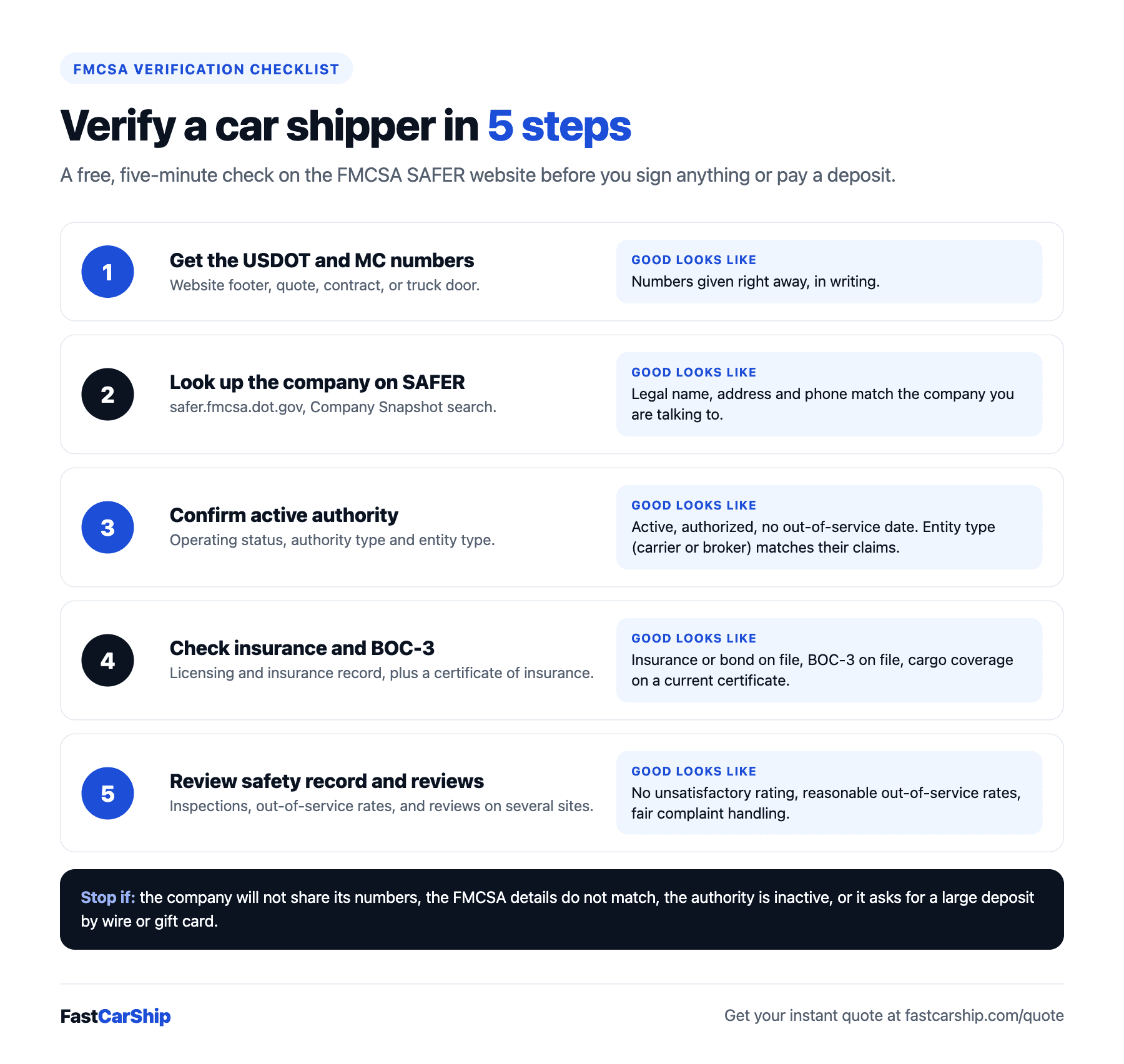
- Get the company's USDOT number and MC number. Licensed companies list them on their website, quote, or contract.
- Look them up on the FMCSA SAFER website at safer.fmcsa.dot.gov and confirm the name, address, and phone match the company you are dealing with.
- Check that the operating authority is active and the entity type is carrier, broker, or both, matching what the company told you.
- Confirm insurance is on file with FMCSA, and ask the carrier for a certificate of insurance that shows cargo coverage.
- Review the safety record and online reviews for patterns of damage, late pickups, or surprise price increases.
Why Verification Matters
The Federal Motor Carrier Safety Administration (FMCSA) regulates companies that move vehicles for hire across state lines. Carriers need a USDOT number and operating authority. Brokers, who arrange shipments with carriers, need broker authority and a bond or trust fund on file.
A company without active authority is not allowed to do this work across state lines. If something goes wrong, you may have no insurance to claim against and no federal record to lean on. Checking takes minutes and filters out most of the bad actors described in our guide to car shipping scams.
Step 1: Find the USDOT and MC Numbers
Start by getting the company's identification numbers.
- USDOT number. A unique number FMCSA assigns to companies that operate commercial vehicles or are otherwise required to register. Carriers always have one, and brokers commonly have one too.
- MC number. Also called a docket number. It identifies the company's operating authority to work for hire across state lines. Brokers and carriers each get one.
Look for these numbers in the website footer, on your quote or contract, or on the truck door for carriers. If you cannot find them, ask. A licensed company gives you its numbers right away. If a company dodges the question or says it "does not need one," stop there.
Step 2: Look Up the Company on FMCSA SAFER
Go to the FMCSA SAFER Company Snapshot. Choose to search by USDOT number or MC/MX number, enter the number, and open the result.
First, check the basics:
- Legal name and DBA name. Does either match the company you are talking to?
- Physical address and phone. Do they match the website and quote?
- Entity type. Is it listed as a carrier, a broker, or both?
A mismatch is a serious warning sign. Scammers sometimes borrow a real company's numbers. If the name or phone does not match, call the phone number listed on FMCSA, not the one on the website, and ask whether they are working with you.
Step 3: Confirm Active Operating Authority
On the snapshot, look at the Operating Status and Operating Authority Status fields.
| Field | What Good Looks Like | Warning Sign |
|---|---|---|
| USDOT Status | Active | Inactive or out of service |
| Operating Authority | Authorized for property (carrier) or broker | Not authorized, revoked, or pending |
| Entity Type | Matches what the company told you | Says carrier but listed only as broker, or the reverse |
| Out of Service Date | None | Any date listed |
| Carrier Operation | Interstate (for carriers) | Intrastate only, for a cross-country move |
| MCS-150 Form Date | Updated in the last two years | Very old or missing |
For more detail, follow the link to the company's licensing and insurance record from the snapshot. That page shows each type of authority (common, contract, or broker), whether it is active, and when it was granted.
A brand-new authority is not automatically bad. Every company starts somewhere. But combine a very new authority with a quote far below the market, a large deposit, and no reviews, and you have a pattern worth avoiding.
If you are not sure whether you are dealing with a broker or a carrier, our guide to auto transport broker vs. carrier explains what each one does and how the entity type should read.
Step 4: Check Insurance and BOC-3 on File
On the licensing and insurance record, look for:
- Insurance on file. Carriers should show liability insurance filed with FMCSA. Brokers should show a bond or trust fund filing.
- BOC-3 on file. This form names a process agent in each state, a legal requirement for authority. "Yes" is what you want.
- No pending cancellation. A notice that insurance is being canceled is a red flag.
FMCSA records show the filings the company is required to keep. They do not always show the full cargo coverage that protects your car. For that, ask the carrier (or your broker, once a carrier is assigned) for a certificate of insurance. Check that:
1. The insured name matches the carrier's FMCSA legal name
2. The policy dates cover your shipping dates
3. Cargo coverage is listed, with a limit that fits your car's value
4. The deductible amount is clear
You can also call the insurance agent named on the certificate to confirm the policy is active. For a high-value or classic car, ask about the cargo limit per vehicle. Many owners of expensive cars choose enclosed transport for added protection.
Step 5: Review Safety Record and Reviews
Safety data
For carriers, the SAFER snapshot shows inspection and crash counts for the past two years, plus out-of-service rates compared to national averages. Look for:
- Safety rating. Satisfactory is good. Conditional deserves a question. Unsatisfactory is a stop. Many carriers have no rating at all, which is common and not a warning sign by itself.
- Out-of-service rates well above the national average for vehicles or drivers.
- Crash counts that seem high for the number of trucks the company runs.
Brokers do not run trucks, so they do not have inspection data. For a broker, the key checks are active broker authority, the bond on file, and its reputation.
Reviews
Read reviews on several sites, not only the company's own website. Pay attention to patterns, not single complaints:
- Prices that went up after booking
- Pickups that slipped by a week or more with no updates
- Damage claims that were ignored
- Deposits that were never refunded
A company with a long record and a handful of fairly handled complaints is often safer than a company with no history at all.
FMCSA Verification Checklist
Use this table as a quick pass/fail check before you book:
| Check | Pass | Fail |
|---|---|---|
| USDOT and MC numbers provided | Given right away | Refused or vague |
| Name, address, phone match FMCSA | Yes | Do not match |
| Authority status | Active | Inactive, revoked, or pending |
| Entity type | Matches the company's claims | Does not match |
| Insurance or bond on file | Yes | Missing or being canceled |
| BOC-3 on file | Yes | No |
| Certificate of insurance (carrier) | Provided, dates current | Refused |
| Reviews | Consistent, with fair complaint handling | Patterns of bait-and-switch or ignored claims |
You can check your car shipping price in under a minute and use this table on the specialists you talk to.
Other Red Flags That FMCSA Will Not Show
Even a company with clean federal records can use bad sales tactics. Watch for:
- A quote far below everyone else's. It may be raised later.
- A large upfront deposit before a carrier is assigned.
- Payment only by wire transfer, gift card, or cash app to a personal account.
- No written contract or Bill of Lading.
- Pressure to decide today.
A trustworthy company is happy to wait while you check. See our full guide to avoiding car shipping scams for more.
How FastCarShip Approaches This
FastCarShip is not a carrier and does not own trucks. FastCarShip gives you an instant car shipping estimate and connects you with professional auto transport specialists who work with licensed, FMCSA-authorized, insured carriers. You can still run every check in this guide yourself, and you should. Learn more about FastCarShip or see how it works from quote to delivery.
If you are shipping as part of a move, our moving out of state car checklist shows where this step fits with your title, registration, and insurance tasks.
Five Minutes That Protect Your Car
Verifying a car shipping company is simple. Get the USDOT and MC numbers, look them up on FMCSA SAFER, confirm the authority is active, check insurance and the BOC-3, and read the safety record and reviews. If everything lines up, you can book with confidence. If anything does not match, ask questions or walk away.
When you are ready to compare a fair price, get your free instant quote for your route. An auto transport specialist will contact you shortly with an accurate quote. Have more questions? Visit our car shipping FAQ or contact our team.
Frequently Asked Questions
How do I check a car shipping company's MC number?
Go to safer.fmcsa.dot.gov, choose the Company Snapshot search, and enter the MC number. Check that the company name, address, and phone match, and that its operating authority is active.
What is the difference between a USDOT number and an MC number?
A USDOT number identifies a company registered with FMCSA. An MC number, or docket number, shows the company's operating authority to work for hire across state lines. Most auto transport carriers and brokers have both.
What should a carrier's FMCSA status say?
For a carrier, the USDOT status should be active and the operating authority should show it is authorized for property. There should be no out-of-service date, and insurance should be on file.
Do car shipping brokers need to be registered with FMCSA?
Yes. Brokers that arrange interstate vehicle shipments need FMCSA broker authority, and they must keep a surety bond or trust fund on file. The snapshot lists them with a broker entity type.
Does FMCSA show a carrier's cargo insurance?
Not always in full. FMCSA records show required filings, so ask the carrier for a certificate of insurance that lists cargo coverage, the coverage limit, the deductible, and current policy dates.
Is a car shipping company with no safety rating safe to use?
Many carriers have no safety rating, because FMCSA does not rate every company. A missing rating is not a red flag by itself. Look at active authority, insurance, out-of-service rates, and reviews instead.
What should I do if a company's FMCSA information does not match?
Do not book or pay. Call the phone number on the FMCSA record and ask whether that company is working with you. Scammers sometimes use real companies' numbers.