Military PCS Car Shipping Within the US (CONUS): Complete Guide
Military PCS car shipping inside the US: what the government covers, when shipping beats driving, timing around your report date, base access and POA tips.
You have PCS orders, a report date, and two cars in the driveway. The movers are handling your household goods, but the cars are a different story. For a move inside the continental United States (CONUS), the military usually expects you to drive your vehicle, not ship it. That leaves many families asking whether it is worth paying to ship a car, and how to time it so the car is waiting when you sign in.
This guide explains what the government typically covers on a CONUS PCS, when shipping a car makes more sense than driving, how to line up pickup and delivery with your orders, and what to know about base access and paperwork. If you already know your route and dates, you can get an instant car shipping quote in under a minute and compare it to the cost of driving.
One note before we start: entitlements change and every situation is different. Use this guide to plan, then confirm the details with your installation transportation office and finance office before you spend money.
Quick Answer: Does the Military Pay to Ship Your Car on a CONUS PCS?
- Usually not. The privately owned vehicle (POV) shipment entitlement is mainly for moves to or from overseas (OCONUS) duty stations. On most moves within the lower 48 states, the government expects you to drive.
- You may get mileage instead. Service members often receive a mileage allowance (MALT) plus per diem for driving, and in many cases this can cover up to two vehicles. Confirm your exact entitlement with your transportation office and finance.
- Shipping is your own expense in most cases, but it can still make sense for a second car, a long cross-country move, or when a spouse would have to drive alone.
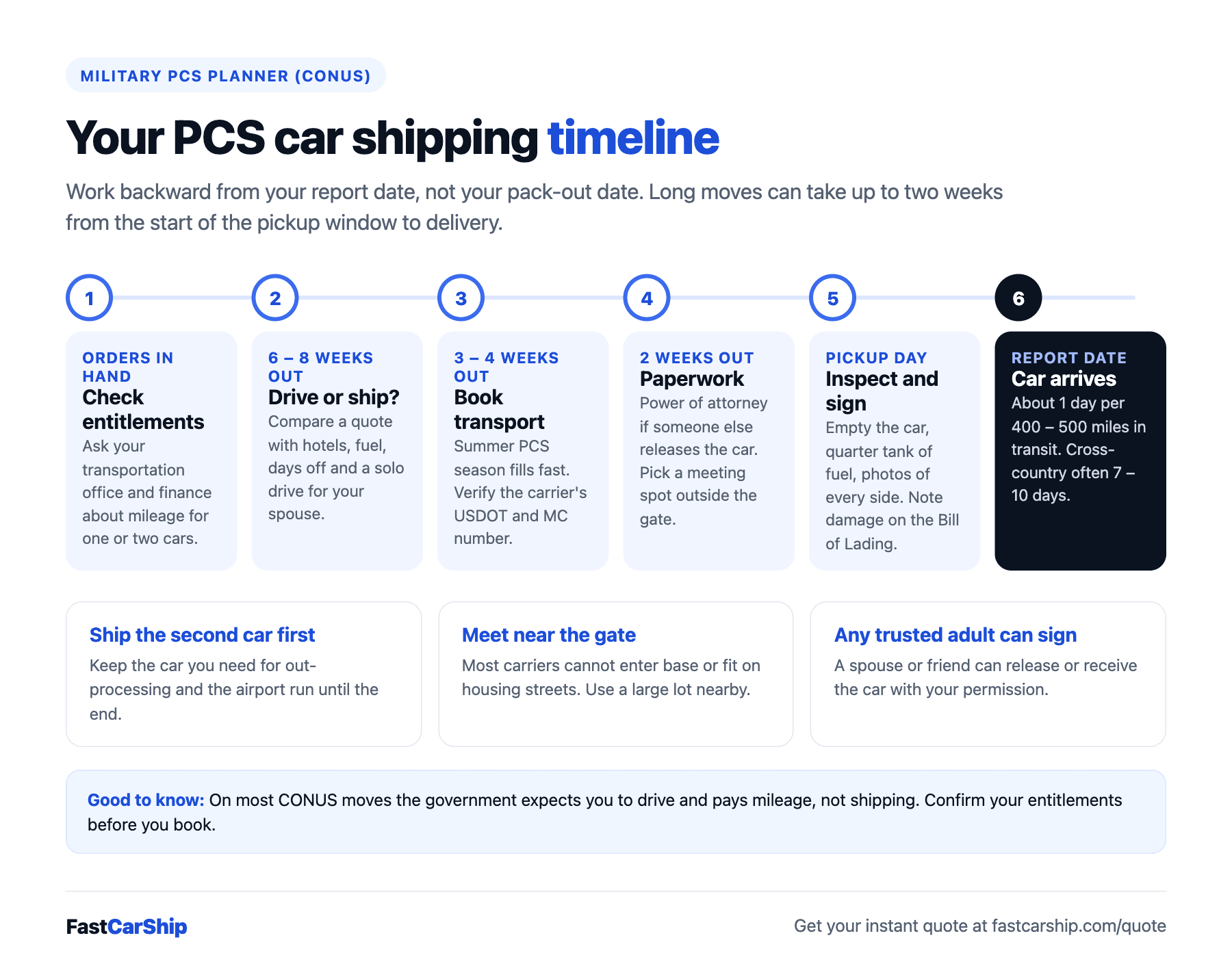
- Book 3 to 4 weeks ahead in summer PCS season, and plan the car's arrival around your report date, not your pack-out date.
What the Government Typically Covers on a CONUS PCS
The rules for moving a POV come from the Joint Travel Regulations, and they are applied by your service's transportation and finance offices. In plain terms, here is how it usually works for a move between two duty stations inside CONUS.
Driving is the default
For most CONUS moves, you are expected to drive your POV to the new duty station. The government typically pays a mileage rate for the official distance and a per diem for the authorized travel days. If your family travels in a second car, that second vehicle may also qualify for mileage. The details depend on your orders, dependents, and service.
POV shipping is mostly an overseas benefit
The government-funded POV shipment program is built for moves to places like Germany, Japan, Korea, Hawaii, and Alaska. Within CONUS, the government generally does not book or pay a commercial carrier to move your car. There are limited exceptions in special situations, so if you think yours qualifies, ask your transportation office in writing.
What to ask your transportation office
Before you decide, get clear answers to these questions:
1. How many vehicles are covered for mileage on my orders?
2. How many travel days am I authorized, and what per diem applies?
3. If I ship a car instead of driving it, how does that change my travel claim?
4. Is any part of a commercial car shipment reimbursable in my situation?
Military OneSource has free PCS planning tools and can point you to the right office if you are not sure where to start.
Drive or Ship? How to Decide
Driving is often the cheapest option on paper, especially when mileage and per diem help cover the trip. But the true cost of a long drive includes hotels, meals, time off, wear on the car, and the stress of a multi-day trip with kids and pets.
| Situation | Usually Better to Drive | Usually Better to Ship |
|---|---|---|
| One car, short move (under 500 miles) | Yes | Rarely |
| One car, cross-country move | Possible | Often, if time is tight |
| Two cars, one adult driver | No | Yes, ship the second car |
| Spouse moving alone while you are deployed or in training | No | Yes |
| Report date leaves little travel time | No | Yes, fly and ship |
| Older car you do not want to put 2,000 miles on | No | Yes |
When shipping makes the most sense
- You have two cars and one driver. This is the most common reason military families ship a car. One adult drives the main vehicle, and the second car goes on a truck.
- Your spouse would drive alone. If the service member reports early, leaves for a school, or deploys during the move, shipping saves the spouse a long solo drive.
- The move is long. A coast-to-coast PCS can mean five or six days of driving. Flying and shipping can get the family settled faster.
- You need to report fast. If your orders leave only a few days between sign-out and sign-in, shipping the car lets you fly and still have wheels when you arrive.
You can compare the price of shipping to the cost of driving with an instant estimate for your route.
What Does It Cost to Ship a Car for a PCS?
Car shipping prices depend on distance, vehicle size, season, and how flexible you are on dates. These are typical industry ranges for a standard sedan on an open carrier.
| Distance | Typical Rate | Example |
|---|---|---|
| Under 500 miles | About $1.00 – $2.00 per mile | North Carolina to Georgia |
| 500 – 1,500 miles | About $0.70 – $1.20 per mile | Texas to Virginia |
| Over 1,500 miles | About $0.50 – $0.80 per mile | Washington State to Georgia |
| Coast to coast | Usually $1,200 – $2,000 | California to the East Coast |
SUVs and trucks often cost more because they take up more space and weight on the trailer. A car that does not run usually adds about $100 to $250. If you need a guaranteed fast pickup, expedited car shipping is available for an extra fee, often $200 to $600 or more.
Most military families choose open car transport. It is the same kind of truck that delivers new cars to dealerships, and it costs much less than enclosed transport. For a full breakdown of price factors, see our car shipping costs guide.
Timing Your Car Shipment Around Your Orders
The biggest planning mistake on a PCS is booking the car around the pack-out date instead of the report date. Here is a simple way to think about it.
Work backward from the report date
Once a carrier picks up your car, transit usually takes about one day for every 400 to 500 miles. Cross-country moves often take 7 to 10 days. On top of that, the pickup window itself is usually 1 to 5 business days. So for a long move, plan for the car to be in transit for up to two weeks from the start of your pickup window.
Watch the PCS season
Summer is peak PCS season and also peak moving season for everyone else. June and July are usually the most expensive and busiest months for auto transport. Our guide on the best time of year to ship a car shows how prices change month by month. If your orders put you in summer, book 3 to 4 weeks ahead.
Do not ship the car you need last
Keep the car you will drive to the old base, the out-processing appointments, and the airport. Ship the second car first so it is on its way while you finish clearing.

Base Access: Pickup and Delivery on a Military Installation
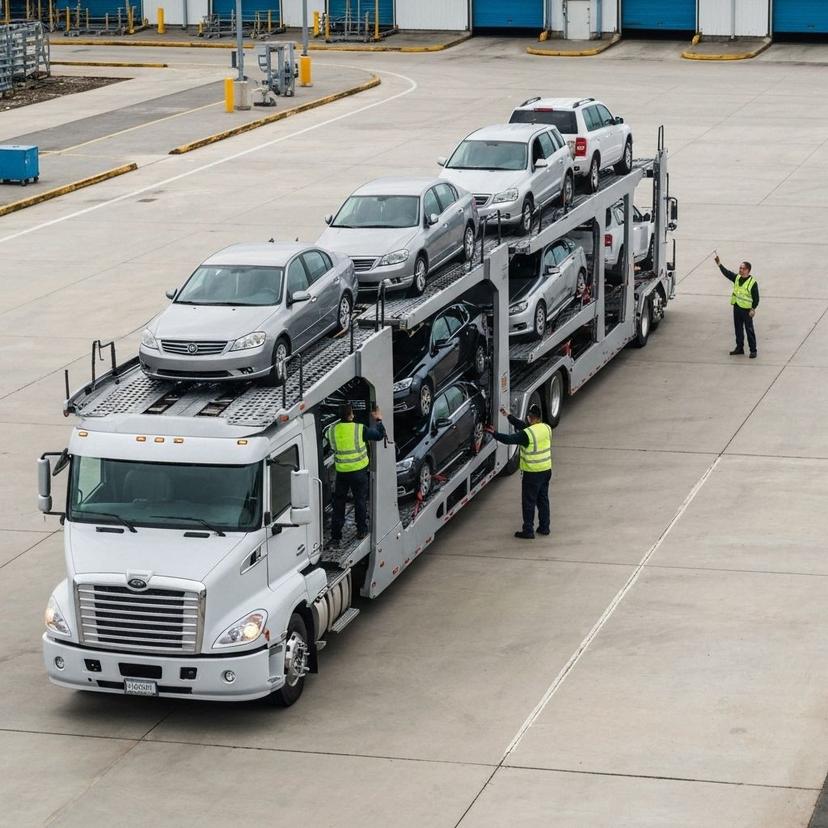
Most car carriers drive large trucks, often 70 to 80 feet long with the trailer. That creates two problems on base: many drivers do not have installation access, and many housing areas have tight streets and low-hanging trees.
Plan to meet outside the gate
The simplest fix is to meet the driver at a large, open parking lot near the base, such as a shopping center or a big-box store. Tell your transport specialist about this up front so the meeting spot is part of the plan. Door-to-door car shipping means the driver comes as close to your address as is legal and safe, and on a military installation that usually means just outside the gate.
If the driver needs base access
Some installations allow a sponsor to escort a commercial vehicle through the visitor center, but rules vary by base and can change with security conditions. Check with the visitor center before you promise a driver they can come in. Never assume a carrier can enter base housing.
Paperwork: Power of Attorney and Releasing the Car
Someone has to hand over the keys and sign the Bill of Lading at pickup, and someone has to inspect and sign at delivery. That person does not have to be the owner, but they must be an adult you trust.
- If you are present: You or your spouse can release and receive the car. Bring photo ID.
- If you are deployed or already at the new base: Give your spouse or a trusted friend a power of attorney if they need to handle the title, registration, or any lender questions. Your installation legal office can usually help with a POA.
- If the car is financed or leased: Check that your lender allows the car to be moved to a new state, and keep their contact information handy for your new registration.
The Bill of Lading is the inspection report and receipt for your car. At pickup and delivery, walk around the car with the driver and note every scratch or dent. If there is new damage at delivery, write it on the Bill of Lading before you sign, take photos, and contact the carrier as soon as possible.
How to Choose a Car Shipping Company for a PCS
Military families are a common target for moving scams because their timelines are tight and their schedules are public. A few checks protect you:
1. Verify the carrier's FMCSA authority. Every interstate carrier must have a USDOT number and operating authority. Our guide on how to verify a car shipping company's FMCSA and MC number walks through it.
2. Know who you are dealing with. Many companies arrange shipping rather than hauling it. Read broker vs. carrier so you understand the difference.
3. Ask about insurance. Carriers must carry cargo insurance. Ask for proof and check the coverage limit.
4. Avoid large upfront deposits and prices far below every other quote.
FastCarShip helps you get an instant estimate and connects you with professional auto transport specialists who work with licensed, insured carriers. If you are ready, see what your PCS route costs.
Getting the Car Ready
Before pickup, empty the car of personal items, leave about a quarter tank of fuel, and photograph every side. Note any leaks or mechanical problems for the driver. Our car shipping preparation tips cover each step.
After the move, you will also need to update your registration, insurance, and possibly your driver's license. Active-duty members often have special options to keep their home-of-record registration and license, but the rules vary by state. Our moving out of state car checklist covers title, registration, and insurance steps in order.
Make Your PCS Car Plan Early
On most CONUS moves, the military expects you to drive, and mileage usually covers that choice. But when you have two cars, one driver, a long distance, or a tight report date, shipping a car can save days of travel and a lot of stress. Confirm your entitlements first, then book the car early and plan pickup and delivery near the gate.
Ready to price it out? Get your free instant quote for your PCS route. An auto transport specialist will contact you shortly with an accurate quote. You can also see how it works from booking to delivery.
Frequently Asked Questions
Does the military pay to ship my car within the US?
Usually not. On most CONUS PCS moves, the government expects you to drive and typically pays mileage and per diem instead. POV shipment is mainly an overseas entitlement, so confirm your situation with your transportation office.
Can I get mileage for two cars on a PCS?
In many cases, service members can receive mileage for up to two vehicles on a PCS, depending on dependents and orders. Ask your transportation office and finance office how it applies to your orders before you travel.
How far in advance should I book car shipping for a PCS?
Book 3 to 4 weeks ahead during summer PCS season and about 2 weeks ahead the rest of the year. Plan around your report date, and allow up to two weeks for pickup and transit on a cross-country move.
Can a car carrier pick up my car on base?
Often not. Many drivers do not have installation access, and large trucks cannot fit on housing streets. Most military families meet the driver at a large parking lot just outside the gate.
Can my spouse release the car if I am deployed?
Yes. Any trusted adult can release the car and sign the Bill of Lading. If your spouse will also handle the title, registration, or lender questions, a power of attorney from your legal office can help.
How long does it take to ship a car across the country for a PCS?
Most cross-country shipments take about 7 to 10 days once the car is picked up, plus a pickup window of 1 to 5 business days. Shorter moves often take 2 to 5 days in transit.