


Car Shipping Calculator: How Auto Transport Pricing Works in 2026
When you request a car shipping quote, you're not just getting a random number. Auto transport pricing follows a formula based on several measurable factors. Understanding how it works puts you in a better position to compare quotes, spot outliers, and book at the right time.
Here's exactly how 2026 car shipping rates are calculated.
The 5 Core Factors That Determine Your Car Shipping Price
1. Distance — The Biggest Variable
Distance is the single largest driver of cost. But it's not purely linear — shorter routes actually cost more per mile than long routes because fixed overhead (truck depreciation, driver time, fuel minimum) gets amortized over fewer miles.
| Distance Range | Avg Cost Per Mile | Typical Total Cost |
|---|---|---|
| Under 500 miles | $0.85 – $1.40/mi | $300 – $600 |
| 500 – 1,000 miles | $0.65 – $0.90/mi | $550 – $850 |
| 1,000 – 1,500 miles | $0.55 – $0.75/mi | $650 – $1,050 |
| 1,500 – 2,000 miles | $0.50 – $0.65/mi | $800 – $1,100 |
| Over 2,000 miles | $0.45 – $0.58/mi | $950 – $1,350 |
Rates above are for standard open transport, sedan or compact SUV. Actual quotes may vary ±15% based on current carrier availability on your lane.
2. Vehicle Size and Weight
Carriers haul multiple vehicles simultaneously on a multi-car trailer. Larger, heavier vehicles take up more deck space and add weight — both reduce how many other vehicles can be loaded, so they cost more.
| Vehicle Type | Size Modifier |
|---|---|
| Motorcycle | −30% to −40% vs sedan |
| Sedan / Coupe | Base rate |
| Compact SUV / Crossover | +5% to +10% |
| Full-size SUV / Minivan | +15% to +25% |
| Full-size Pickup Truck | +20% to +30% |
| Lifted / Oversized Truck | +35% to +50% |
| Exotic / Supercar (low clearance) | +15% to +30% + enclosed required |
3. Open vs. Enclosed Transport
Open transport is the standard — your vehicle rides on an uncovered multi-car trailer, the same type used to deliver new vehicles to dealerships. Enclosed transport uses a covered trailer and costs significantly more.
| Transport Type | Cost vs Open | Best For |
|---|---|---|
| Open transport | Base rate | Daily drivers, SUVs, trucks, most vehicles |
| Enclosed transport | +40% to +55% | Luxury, classic, exotic, low-clearance vehicles |
| Soft-sided enclosed | +25% to +35% | Mid-range protection, convertibles |
The vast majority of vehicles — roughly 85–90% — ship open without any issue. Road grime and light weather exposure are normal and don't damage vehicles.
4. Season and Lane Demand
Auto transport is a marketplace. When more people want to ship in a specific direction during a specific time, prices go up. Key seasonal patterns:
- Summer (June–August): National peak — college move-ins, summer relocations, snowbird "off-season" deals end
- Snowbird season (Oct–Jan): Florida-bound routes spike 20–35%; FL→North routes are cheaper
- Spring reverse (Mar–May): Florida-north routes spike; south-bound routes discount
- Winter (Jan–Feb): Midwest and Mountain routes may see delays or surcharges due to weather
The best way to get the lowest rate is to have date flexibility. Being able to ship within a 5–7 day window (rather than a fixed date) saves $50–$150 on most routes.
5. Origin and Destination Location
Carriers run dense networks on major highways. Locations close to interstates and metropolitan areas get picked up faster and cheaper. Rural locations add cost because a carrier has to deviate from their route.
| Location Type | Effect on Price |
|---|---|
| Major metro, on Interstate corridor | Base rate |
| Suburban, within 30 miles of metro | +$0 to +$50 |
| Small city, 30–75 miles from metro | +$50 to $150 |
| Rural, 75+ miles from major highway | +$150 to $300 |
Why Quotes Vary So Much Between Brokers
You'll notice auto transport quotes can vary by $200–$400 for the same shipment. This happens because:
- Brokers set different broker fees (typically $100–$250 on top of the carrier rate)
- Some quotes are "estimated" and will be adjusted when a carrier actually bids on your load
- Very low quotes may indicate a broker will struggle to find a carrier at that price
- Some quotes include door-to-door; others expect you to meet at a terminal
A quote that's significantly lower than others ($150+ below market) is a red flag. If a carrier can't be found at that price, your shipment sits — sometimes for weeks.
What's NOT Included in Standard Quotes
Read the fine print before booking:
- Expedited pickup (adds $150–$300 for guaranteed pickup within 24–48 hours)
- Inoperable vehicle handling (adds $150–$300 if car doesn't run)
- Extra-long vehicles — some oversized trucks require special permits
- Storage fees if you're not available for delivery (usually $25–$50/day)
How to Get an Accurate Quote
Online calculators give estimates. For a real binding quote, provide:
- Exact pickup ZIP code and delivery ZIP code
- Year, make, model, and trim (trim affects vehicle height/weight)
- Whether the vehicle runs and drives
- Your target pickup date range (wider = better rates)
- Whether you need open or enclosed
Quotes are typically valid for 7–10 days. Prices shift with fuel costs and carrier availability, so don't wait too long to book after receiving a quote you like.
Frequently Asked Questions
How is car shipping cost calculated per mile?
Distance is the primary factor, but cost-per-mile decreases as distance increases. Short hauls (under 500 miles) run $0.85–$1.40/mile; cross-country (over 2,000 miles) runs $0.45–$0.58/mile. Vehicle size, season, and location type all apply on top of the mileage base.
Does a car shipping calculator give accurate quotes?
Online calculators give reliable estimates within 10–15% of final pricing. The exact rate is confirmed when a carrier accepts the load. Provide accurate vehicle dimensions and flexible dates for the most accurate estimate.
Why is my car shipping quote higher than last year?
Diesel fuel prices, insurance costs, and driver wage inflation have all increased since 2023. 2026 rates are roughly 8–12% higher than 2022 rates. However, competition among brokers keeps prices from rising dramatically on high-volume lanes.
Can I negotiate a lower car shipping price?
Yes, but within limits. Brokers have some flexibility on their fee (typically $50–$100 off). The carrier rate itself is market-driven. The most effective way to lower your price: book during off-peak times, have flexible dates, and compare 3–4 quotes from different brokers.
Use our instant quote form to get a real-time price for your specific route — no email required, results in under 60 seconds.
Ready to ship your car? Get an instant quote
Enter your route for real 2026 pricing — about 60 seconds, no email needed for an estimate.
Frequently Asked Questions
Quick answers to common questions about car shipping
Related Articles

Cross Country Car Shipping: 2026 Costs, Timelines & Complete Guide
Shipping a car across the country in 2026? Real coast-to-coast costs ($800–$1,400), 7–10 day transit times, major route breakdowns, and how to avoid the common cross-country mistakes.
Cheapest Way to Ship a Car in 2026: 9 Proven Ways to Save
Looking for the cheapest way to ship a car in 2026? Learn 9 proven strategies that cut auto transport costs by $100–$400 — without falling for low-ball quote scams.
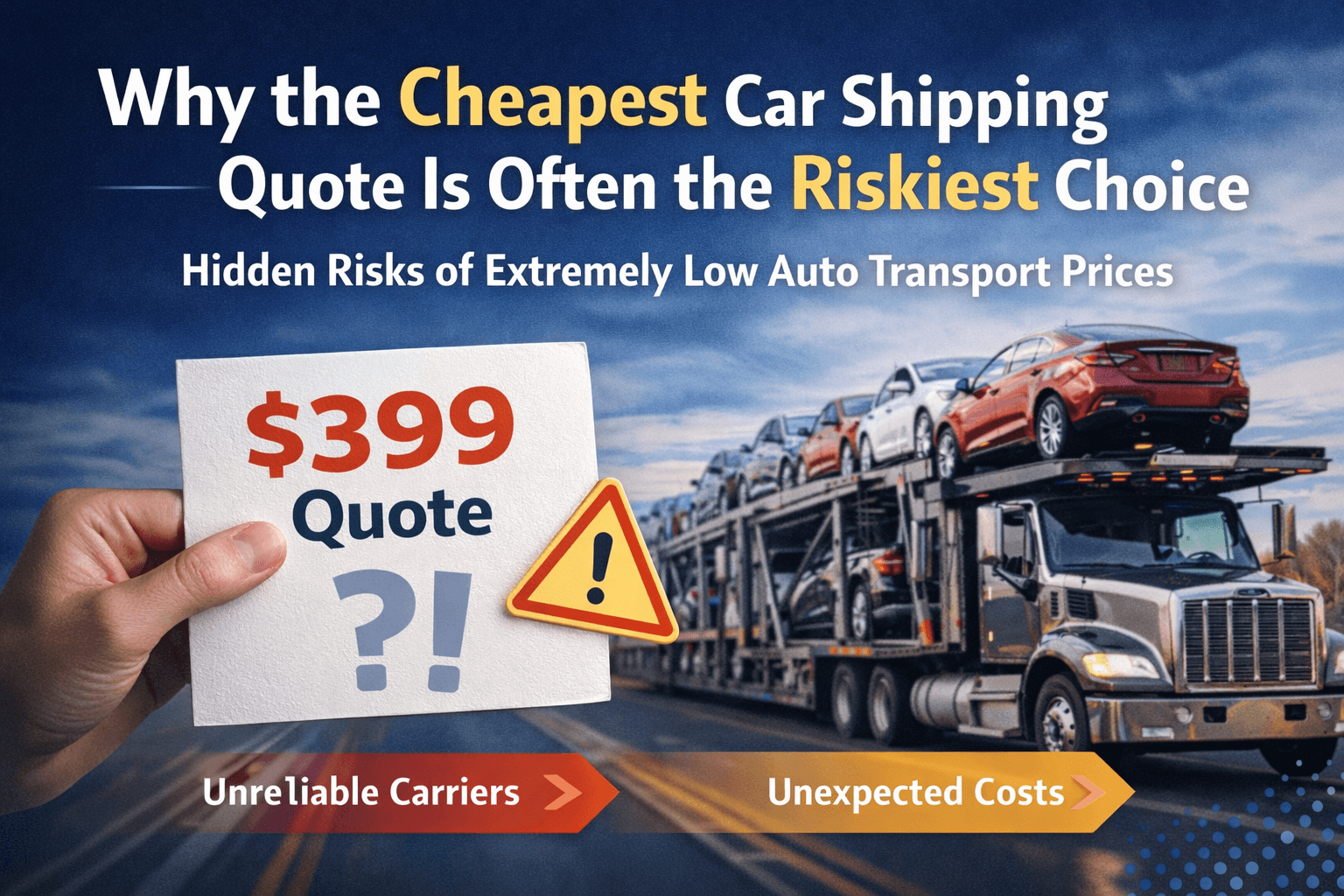
Why the Cheapest Car Shipping Quote Is Often the Riskiest Choice
The cheapest car shipping quote can sometimes lead to delays, cancellations, or unexpected fees. Learn why extremely low quotes in auto transport often carry hidden risks.
Ready to Ship Your Car?
Get an instant quote and experience hassle-free car shipping.
Get Free Quote →